Jeff Nippard Upper/Lower Program: A Comprehensive Guide
Jeff Nippard’s program, available as a PDF, offers structured upper/lower splits – both 4x and 6x weekly options – focused on hypertrophy and strength gains.
Program Overview
Jeff Nippard’s Upper/Lower program is a meticulously designed strength training regimen gaining significant popularity. Available as a downloadable PDF guide, it’s structured around alternating upper and lower body workouts across a weekly schedule. The program notably features two primary variations: a 4x per week version geared towards a balance of size and strength, and a more demanding 6x per week iteration for those seeking accelerated progress.

Both versions emphasize progressive overload and strategic rep range selection to maximize muscle hypertrophy and strength development. The PDF provides detailed exercise lists, set/rep schemes, and recommended RPE (Rate of Perceived Exertion) levels, making it accessible to intermediate to advanced lifters. It’s a comprehensive resource for building a well-rounded physique.
What is the Jeff Nippard Upper/Lower Program?
Jeff Nippard’s Upper/Lower program, detailed in a comprehensive PDF guide, is a periodized strength training plan built around dividing workouts between upper and lower body muscle groups. This split allows for focused training volume and recovery for each muscle group. The program isn’t a rigid, one-size-fits-all approach; it offers flexibility with both 4x and 6x weekly training frequencies.
The PDF outlines specific exercises, sets, repetitions, and RPE targets, providing a clear roadmap for each workout. It’s designed to promote both hypertrophy (muscle growth) and strength gains, appealing to a broad range of fitness goals. Nippard’s approach emphasizes evidence-based training principles, making it a scientifically sound program.
Program Variations: 4x vs. 6x
Jeff Nippard’s program, available as a PDF, presents two primary variations: a 4x per week and a 6x per week schedule. The 4x version is ideal for individuals with less training experience or those who prefer more recovery time between sessions. It typically involves two upper body and two lower body workouts each week.
The 6x variation, detailed within the PDF, caters to more advanced lifters seeking higher training frequency and volume. This split involves three upper and three lower body workouts, demanding greater recovery capacity. Both versions utilize similar exercise selections, differing primarily in the total weekly workload. Choosing between them depends on individual recovery abilities and training goals.
Understanding the Core Principles
Jeff Nippard’s PDF program centers around hypertrophy, strength development, and progressive overload, utilizing strategic rep ranges for optimal muscle growth and power.
Hypertrophy Focus
Jeff Nippard’s program, detailed in the PDF guides, prioritizes muscle hypertrophy through scientifically-backed principles. The program isn’t solely about lifting heavy; it’s about creating optimal conditions for muscle protein synthesis. This is achieved through carefully selected exercises, strategically chosen rep ranges – often falling within the 6-12 range – and sufficient training volume.
The PDF emphasizes the importance of time under tension, ensuring muscles are adequately stressed to stimulate growth. Exercise selection leans towards compound movements, maximizing muscle fiber recruitment, alongside isolation exercises to target specific muscle groups. The program’s structure, whether the 4x or 6x weekly split, is designed to provide enough stimulus for hypertrophy without overtraining, allowing for consistent progress. Proper form and mind-muscle connection are also highlighted as crucial components for maximizing hypertrophic adaptations.
Strength Development
While prioritizing hypertrophy, Jeff Nippard’s program, outlined in the PDF guides, also incorporates elements crucial for strength development. The program isn’t exclusively focused on high-rep sets; it strategically includes lower rep ranges (often 3-5) for key compound lifts like squats, bench press, and deadlifts. This stimulates the nervous system and promotes increases in maximal strength.
The PDF details progressive overload as a cornerstone of strength gains, encouraging users to consistently increase weight, reps, or sets over time. Proper form is paramount, ensuring efficient force production and minimizing injury risk. The program’s structure allows for both structural strength gains (increasing one-rep max) and relative strength gains (improving strength-to-weight ratio). It’s a balanced approach, building a foundation of muscle mass and the ability to express that strength.
Progressive Overload
Progressive overload is central to Jeff Nippard’s program, as detailed in the PDF guides. It’s not simply about adding weight each workout, but a systematic approach to continually challenging the muscles. The program advocates for multiple methods: increasing weight, adding reps, reducing rest times, or improving exercise technique.
The PDF emphasizes tracking workouts to monitor progress and identify areas for improvement. Small, incremental increases are encouraged over drastic jumps, minimizing risk of injury. Auto-regulation, using RPE (Rate of Perceived Exertion), allows for adjustments based on daily readiness. This ensures overload is applied effectively, even on days when strength levels fluctuate. The program’s structure facilitates consistent, sustainable progress, leading to long-term strength and hypertrophy gains.
Rep Range Considerations
Jeff Nippard’s PDF program strategically utilizes varying rep ranges to maximize both hypertrophy and strength. Lower rep ranges (3-5) are incorporated for compound movements, prioritizing strength development. Moderate rep ranges (6-12) form the core of the program, ideal for muscle growth. Higher rep ranges (15+) are occasionally used for isolation exercises or to induce metabolic stress.
The PDF doesn’t prescribe rigid adherence to specific ranges; instead, it encourages a blend. RPE is crucial – selecting a weight that challenges you within the target rep range. Periodization within the program cycles through these ranges, preventing plateaus and stimulating continued adaptation. This nuanced approach, detailed in the guide, optimizes results for diverse training goals.

Detailed Workout Structure
Jeff Nippard’s PDF meticulously details four distinct workouts: Upper A, Upper B, Lower A, and Lower B, each with specific exercises, sets, reps, and RPE guidance;
Upper Body Workout A
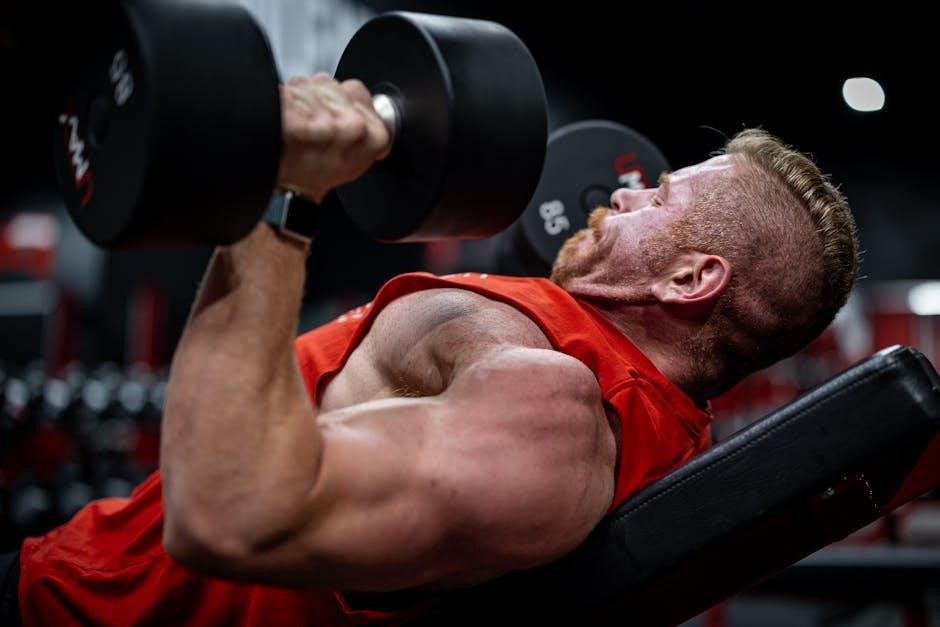
Upper Body Workout A, as outlined in the Jeff Nippard program PDF, typically emphasizes pushing movements and overall upper body strength. Expect exercises like incline dumbbell press, flat barbell bench press, and overhead pressing variations.
The program details specific set and rep schemes, often incorporating a mix of rep ranges to stimulate both hypertrophy and strength. Accessory work frequently includes exercises targeting the rear deltoids and triceps, such as face pulls and close-grip bench press.
Form cues and RPE (Rate of Perceived Exertion) guidance are provided within the PDF to ensure proper execution and optimal stimulus. This workout aims to build a solid foundation of upper body pushing strength and muscle mass.

Exercise Selection ─ Upper A
Exercise selection for Upper Body Workout A, detailed in the Jeff Nippard program PDF, prioritizes compound movements. Core lifts commonly include incline dumbbell press, focusing on upper chest development, and flat barbell bench press for overall chest strength. Overhead pressing variations, like barbell or dumbbell shoulder press, target the deltoids.
Accessory exercises are strategically chosen to address muscle imbalances and enhance overall upper body development. These often include variations of rows, targeting the back muscles, and isolation exercises for the biceps. The PDF emphasizes selecting exercises that align with individual anatomy and goals.
Proper form and controlled movements are crucial, as highlighted in the program’s guidance.

Sets, Reps, and RPE ─ Upper A
Jeff Nippard’s Upper A workout, as outlined in the program PDF, typically employs a range of 3-4 sets per exercise. Rep ranges vary depending on the exercise and training phase, often falling between 6-12 reps for hypertrophy-focused work. The program heavily utilizes Rate of Perceived Exertion (RPE) to gauge intensity.
RPE is commonly used on a scale of 1-10, with most working sets performed at an RPE of 7-9, indicating significant effort but leaving 1-3 reps “in the tank.” The PDF provides guidance on interpreting RPE accurately; Rest intervals are generally between 60-90 seconds.
Progressive overload is achieved by increasing weight, reps, or sets over time, guided by RPE feedback.
Upper Body Workout B
Upper Body Workout B, detailed within Jeff Nippard’s program PDF, serves as a complementary session to Upper A, targeting slightly different muscle groups and movement patterns. This workout often prioritizes horizontal pushing and pulling movements. Expect exercises like incline dumbbell press, cable rows, and potentially face pulls to emphasize rear deltoid development.
The PDF outlines specific exercise selections, set/rep schemes, and recommended RPE ranges for each exercise. It’s designed to create a balanced upper body stimulus when paired with Workout A.
Variations exist between the 4x and 6x weekly programs, influencing exercise volume and frequency.
Exercise Selection ― Upper B
Jeff Nippard’s PDF for the Upper/Lower program details a strategic exercise selection for Upper Body Workout B. Commonly, this session features movements emphasizing horizontal pressing and pulling. Expect to find variations of rows – like cable rows or barbell rows – alongside incline dumbbell presses, targeting the upper chest.
Rear delt focused exercises, such as face pulls, are frequently included to balance shoulder development. The PDF may also incorporate bicep and tricep isolation work.
Exercise choices can slightly vary based on the 4x or 6x program split, with the latter potentially including more volume and exercise variety.
Sets, Reps, and RPE ─ Upper B
Jeff Nippard’s PDF outlines specific set, rep, and Rate of Perceived Exertion (RPE) guidelines for Upper Body Workout B. Generally, you can anticipate a range of 3-4 sets per exercise. Rep ranges typically fall between 6-12 for hypertrophy-focused work, and potentially lower, around 4-8, for strength-oriented movements.
RPE is a crucial component, with Nippard advocating for working within an RPE of 7-9, meaning you have 1-3 reps left in the tank. The PDF will detail these parameters for each exercise.
The 6x weekly program often incorporates higher volume, potentially increasing sets or adding exercises.
Lower Body Workout A
Jeff Nippard’s PDF program structures Lower Body Workout A to prioritize foundational movements and overall leg development. Expect a focus on compound exercises targeting quads, hamstrings, and glutes. Common exercises include variations of squats – back squats, front squats, or box squats – alongside Romanian Deadlifts (RDLs) to emphasize the posterior chain.
Accessory work often includes leg press, leg extensions, and hamstring curls to address specific muscle groups. The PDF details the precise exercise selection, set, rep, and RPE schemes.
The 4x program typically features a slightly lower volume compared to the 6x version.
Exercise Selection ― Lower A
Jeff Nippard’s PDF for Lower Body Workout A consistently features a core of compound lifts. The primary movement is typically a squat variation – Back Squats are common, but Front Squats or Box Squats are also utilized depending on individual needs and goals. Romanian Deadlifts (RDLs) are a staple, targeting the hamstrings and glutes.
Accessory exercises are strategically chosen to complement the main lifts. These often include Leg Press, providing a different stimulus for the quads, and variations of Leg Curls to isolate the hamstrings. Glute-focused work, like Hip Thrusts, may also be included.
The PDF provides detailed rationale for each exercise choice.
Sets, Reps, and RPE ─ Lower A
Jeff Nippard’s PDF outlines a specific structure for sets, reps, and Rate of Perceived Exertion (RPE) in Lower Body Workout A. Generally, compound movements like squats are performed for 3-4 sets of 6-10 repetitions, utilizing an RPE of 7-9. This range encourages both strength and hypertrophy.
RDLs typically follow a similar set/rep scheme, but may lean towards slightly higher reps (8-12) with a comparable RPE. Accessory exercises, such as Leg Press and Leg Curls, often involve 3 sets of 10-15 reps, with an RPE of 6-8.
The PDF emphasizes leaving 1-2 reps “in the tank” per set, ensuring proper form and avoiding burnout.
Lower Body Workout B
Jeff Nippard’s PDF details Lower Body Workout B as a complementary session to Lower A, focusing on slightly different movement patterns and muscle emphasis. This workout commonly begins with variations of the squat, such as Front Squats or Box Squats, performed for multiple sets.
Expect to find exercises like Romanian Deadlifts (RDLs) or Good Mornings included, targeting the posterior chain. Lunges, whether walking or stationary, are frequently incorporated to address unilateral leg strength.
Accessory work often includes hamstring curls, glute bridges, and calf raises, completing a well-rounded lower body stimulus. The PDF provides specific exercise selections and rep ranges.
Exercise Selection ― Lower B
Jeff Nippard’s PDF program typically structures Lower Body Workout B around movements differing from Lower A, ensuring comprehensive leg development. Core exercises often include variations of the squat, like Front Squats, emphasizing quad activation. Romanian Deadlifts (RDLs) or Good Mornings are frequently chosen to target the hamstrings and glutes.
Unilateral work, such as Bulgarian Split Squats or Walking Lunges, is a staple, addressing imbalances and improving stability. Accessory movements commonly feature hamstring curls, glute bridges, and calf raises for targeted muscle growth.
The PDF emphasizes selecting exercises that align with individual biomechanics and goals, offering alternatives where appropriate.
Sets, Reps, and RPE ― Lower B
Jeff Nippard’s PDF program for Lower Body B generally prescribes a range of 3-4 sets per exercise, focusing on a rep scheme that varies based on the movement and training phase. Compound lifts, like squats and RDLs, often fall within the 6-10 rep range, prioritizing strength and hypertrophy.
Isolation exercises, such as hamstring curls, may utilize a higher rep range of 10-15. RPE (Rate of Perceived Exertion) is a crucial component, with Nippard advocating for an RPE of 7-9, leaving 1-3 reps “in the tank” on most sets.
The PDF details specific RPE targets, ensuring sufficient intensity for muscle growth while managing fatigue effectively.

Program Implementation
Jeff Nippard’s PDF emphasizes proper warm-ups, cool-downs, rest intervals, and strategic deloading to maximize results and prevent plateaus during the program.
Warm-up Protocols
Jeff Nippard’s program PDF details crucial warm-up protocols before each upper and lower body session. These aren’t simply static stretches; instead, they prioritize dynamic movements to increase blood flow and prepare the target muscle groups.
A typical warm-up includes general movements like light cardio – five minutes on a treadmill or elliptical – followed by specific exercises mirroring the workout. For example, before squats, perform bodyweight squats, glute bridges, and leg swings. Before bench press, include arm circles, band pull-aparts, and light dumbbell presses.
The goal is to gradually increase the intensity and range of motion, priming the nervous system and reducing injury risk. Nippard stresses the importance of feeling prepared and ‘switched on’ before attempting working sets, as outlined in the program guide.
Cool-down and Stretching
Jeff Nippard’s PDF program emphasizes a dedicated cool-down phase post-workout, though it differs from traditional prolonged static stretching. He advocates for light cardio, like walking, for 5-10 minutes to aid recovery and reduce muscle soreness.
Static stretching is recommended, but strategically. Nippard suggests focusing on the muscles worked during the session, holding each stretch for 30-60 seconds. However, he cautions against excessive stretching before lifting, as it can temporarily reduce strength.
The cool-down aims to gradually lower heart rate and promote blood flow, assisting in nutrient delivery and waste removal. The program guide details specific stretches beneficial for each muscle group, optimizing recovery and flexibility.
Rest Intervals
Jeff Nippard’s PDF program meticulously outlines rest intervals, crucial for maximizing both hypertrophy and strength. For compound movements – squats, bench press, deadlifts – longer rests of 2-3 minutes are prescribed, allowing for near-full recovery between sets. This supports maintaining intensity and lifting heavier weights.
Isolation exercises, however, utilize shorter rest periods, typically 60-90 seconds. This increases metabolic stress, a key driver of muscle growth. Nippard emphasizes that these are guidelines, and individual recovery needs may necessitate adjustments.
The program stresses the importance of actively resting – avoiding phone scrolling and focusing on breathing – to optimize recovery during those intervals.
Deloading Strategies
Jeff Nippard’s PDF program acknowledges the necessity of deloading to prevent overtraining and plateaus. He recommends a deload week every 4-8 weeks of consistent training, depending on individual recovery capacity and training intensity.
A common deload strategy involves reducing training volume by 40-50% while maintaining the same frequency. This means decreasing sets, but continuing with the same exercises. Alternatively, intensity can be reduced by lowering the weight lifted by a similar percentage.
Nippard stresses that a deload isn’t about complete rest; it’s about reduced stress. Active recovery, like light cardio or mobility work, is encouraged during the deload week.
Advanced Considerations
Jeff Nippard’s PDF guides offer exercise substitutions, scaling options for experience levels, and emphasize nutrition’s role alongside training for optimal results.

Exercise Substitutions
Jeff Nippard’s program, detailed in the PDF guides, acknowledges that equipment availability and individual preferences necessitate exercise substitutions. For example, if barbell back squats aren’t feasible, front squats or leg presses are viable alternatives. Similarly, pull-ups can be swapped for lat pulldowns.
The key is maintaining the same movement pattern and muscle group focus. When substituting, consider the load and range of motion to ensure continued progressive overload. Nippard emphasizes prioritizing exercises that minimize joint stress while effectively targeting the intended muscles. The PDF often suggests multiple substitution options, allowing for personalized program adjustments. Don’t be afraid to experiment, but always prioritize proper form and technique over simply mimicking the original exercise.
Scaling for Different Experience Levels
Jeff Nippard’s PDF program caters to various fitness levels through adjustable parameters. Beginners can reduce the training frequency, opting for the 4x weekly schedule instead of 6x. Lowering the weight and focusing on mastering form is crucial.
Intermediate lifters can adhere to the 6x schedule, utilizing the prescribed rep ranges and RPE. Advanced lifters can increase the weight, incorporate advanced techniques like drop sets, and potentially adjust the exercise selection for greater challenge. The PDF emphasizes auto-regulation – listening to your body and adjusting the load based on daily readiness. Prioritizing proper technique remains paramount, regardless of experience level, ensuring safe and effective progression.
Nutrition for Optimal Results
Jeff Nippard’s program PDF stresses that training is only part of the equation; nutrition is vital for maximizing results. A caloric surplus is generally recommended for muscle growth, alongside sufficient protein intake – around 0.8-1 gram per pound of bodyweight.
Prioritize whole, unprocessed foods, ensuring adequate carbohydrate intake to fuel workouts and replenish glycogen stores. Hydration is also key. While the PDF doesn’t prescribe a rigid diet, it highlights the importance of consistent, mindful eating. Tracking macronutrients can be beneficial, especially for those new to nutrition. Optimizing nutrient timing around workouts may further enhance recovery and performance, supporting the program’s hypertrophy goals.
Supplementation (Optional)
Jeff Nippard’s program PDF clarifies that supplementation is entirely optional and should complement, not replace, a solid nutritional foundation. Creatine monohydrate is highlighted as the most research-backed supplement for strength and muscle growth, potentially enhancing performance.
Protein powder can be a convenient way to meet daily protein targets, particularly post-workout. Other supplements, like citrulline malate or beta-alanine, may offer marginal benefits, but aren’t essential. The PDF emphasizes individual needs and responses. Prioritize a well-rounded diet before considering supplements, and always research thoroughly before adding anything new to your regimen. Focus on consistency with training and nutrition first.

Resources and Further Learning
Jeff Nippard’s official website and YouTube channel provide extensive content, including detailed explanations of his PDF programs and exercise technique tutorials.
Jeff Nippard’s Website and YouTube Channel
Jeff Nippard’s website (jeffnippard.com) serves as a central hub for his training programs, including the Upper/Lower splits available as PDF guides. You’ll find detailed program descriptions, frequently asked questions, and options for purchase. However, a wealth of free information is also available.
His YouTube channel is an invaluable resource, offering in-depth exercise tutorials, form critiques, and explanations of the scientific principles underpinning his training philosophy. Many videos directly address the Upper/Lower program, breaking down exercise selection, proper technique, and common mistakes. He frequently discusses progressive overload and hypertrophy, concepts central to the program’s effectiveness. Subscribing provides access to a constantly growing library of fitness knowledge, supplementing the PDF guide with visual demonstrations and expert insights.
PDF Program Guide Availability

The Jeff Nippard Upper/Lower program is primarily accessed through purchase of the official PDF guide, available on his website, jeffnippard.com. Two main versions exist: a 4x per week program emphasizing size and strength, and a 6x per week version geared towards increased training volume.
These PDF documents comprehensively detail each workout, including exercise selection, sets, repetitions, RPE (Rate of Perceived Exertion) guidelines, and rest intervals. Course Hero and other online platforms may host copies, but purchasing directly supports Nippard’s work and ensures you receive the most up-to-date version; The guides are structured for both intermediate and advanced lifters, offering a robust framework for building muscle and strength.